Find out more about East Galway:
www.ballinasloe.com
www.lawrencetown.com
www.killimor.org
http://clontuskert.
scoilnet.ie
ABOUT CLONTUSKERT
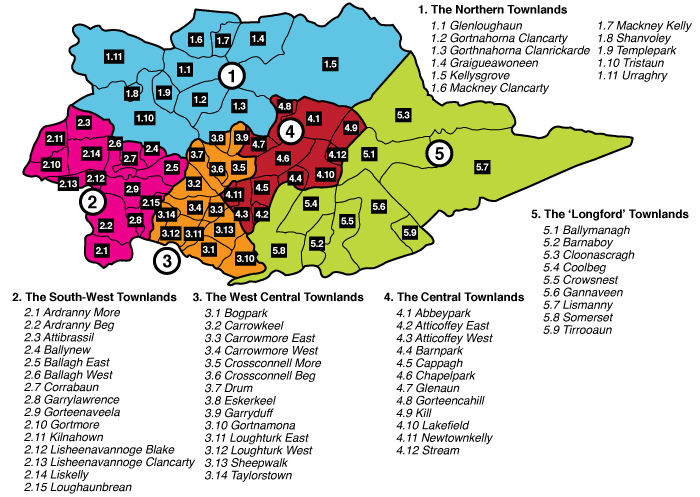
The parish of Clontuskert is situated on the eastern edge of County Galway in the West of
Ireland. It lies in rural countryside to the south of the town of Ballinasloe, straddling the roads
leading to Lawrencetown and Kiltormer. The river Suck forms its eastern border and the parish
of Aughrim lies on its western side. Ballinasloe parish is to the north, while the parishes of
Lawrencetown and Kiltormer define its southern limits.
Clontuskert is an entirely rural parish where the majority of the people are farmers, deriving their
living from its excellent agricultural soil. The remainder work in the local town of Ballinasloe or
further afield in Athlone or Galway. Access to these towns has improved dramitically since the
opening of the new M6 motorway between Galway and Dublin.
The following section contains brief pen pictures of the built and cultural heritage of Clontuskert which are dealt with more extensively in our book, The Parish of Clontuskert - Glimpses into its Past. Click on the photos for larger versions.
|
Bronze Age Burials | |
|
Clontuskert is fortunate in that a number of burial mounds monuments, known as barrows,
cairns or tumuli, survive. This monument type, dating from around 2000 B.C., is a rich source
of information on past societies. A barrow is generally defined as a mound of earth, or earth
and stone, which is generally associated with burial. These monuments sometimes occur
in isolation, as in Ardranny, or in groups, such as the four on the eastern side of the parish,
two of which are in Somerset, one in Coolbeg and one in Barnaboy. Many of the Clontuskert
barrows are associated with water, or watery places. The building of such monuments may
be symbolically regarded as the creation of another world, a place to which the dead depart.
|
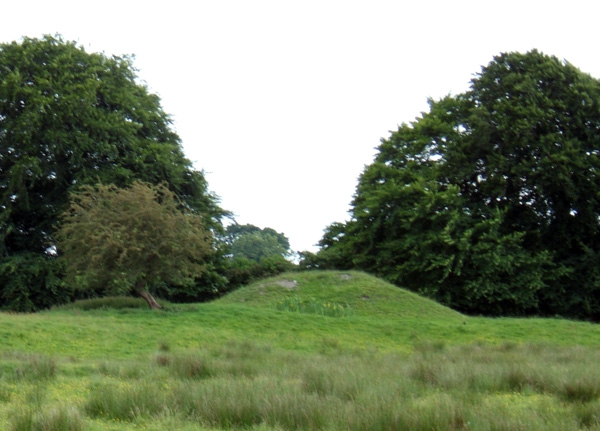
Barrow at Somerset |
|
Somerset Hoard | |
|
In the mid 1950s, one of the greatest discoveries from the Irish Iron Age, the Somerset Hoard,
was found within the rich landscape of prehistoric monuments in Somerset townland. A local
farmer, Mick Hanney, discovered a hoard of decorative objects as he tilled one of his fields. One
object, a torc, is made from gold and the remainder are of copper alloy. All were made in Ireland
during the first century A.D. This collection is now housed in the National Museum.
|

Somerset Hoard |
|
Ringforts | |
|
A remarkable feature of Clontuskert is the number of its ringforts, over a hundred in all, with
which the landscape of the parish is studded. These structures may date from the middle of
the 2nd century A.D. to the middle of the 14th century A.D. although the majority of them were
constructed in the latter half of the 10th century. Ringforts are generally regarded as farmsteads
built to provide security. They were constructed on raised areas, usually on the summit of
a small hill, enclosed by a bank, and containing one or more simple houses.
|
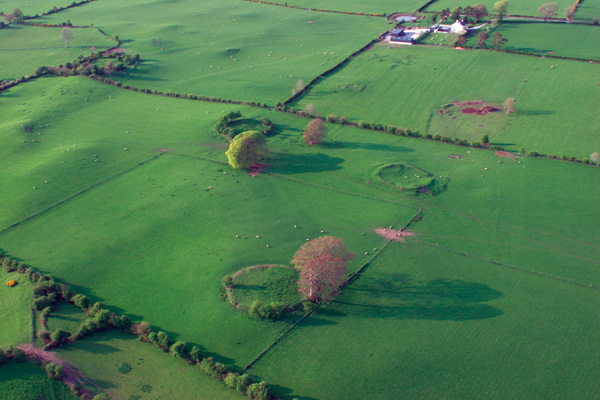
Ringforts in Carrowmore |
|
The Old Abbey | |
|
The Augustinian Priory of St. Mary, known locally as the 'Old Abbey', represents Clontuskert's
main claim to fame. It was reputedly built on the site of St. Baetan's earlier Celtic monastery.
The building of the Priory, founded by the Canons Regular of St. Augustine, was begun in the
late 1100s. It survived as a monastic settlement until the early part of the 17th century, having
undergone several reconstructions and additions during those years.
|
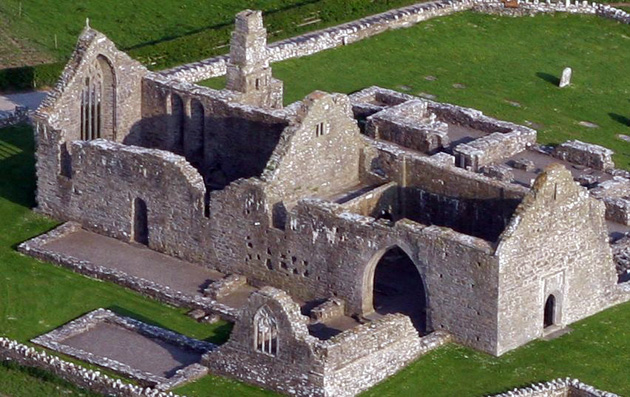
Old Abbey |
|
Somerset House | |
|
Somerset House was the home of the Seymour family until 1945. The Seymours originated
in Wiltshire, England and settled in Clontuskert in the early 1700s, at which time they were
given a grant of land by the Eyre family in payment for their services as officers during the
Cromwellian campaign. A member of the English branch of the family, Lady Jane Seymour, was
one of the wives of Henry V111.
|
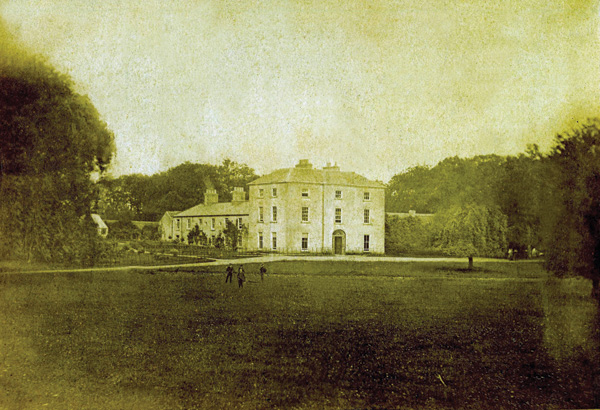
Somerset House 1875 |
|
Battle of Aughrim | |
|
A very considerable portion of the battlefield of Aughrim lies east of the Melehan river in the
parish of Clontuskert. The Williamite troops were situated on that side of the river until the
late afternoon of the day of battle, at which time they launched a major offensive along a wide
front stretching from Attibrassil Bridge to the village of Aughrim. Ginkel, the Williamite general,
commanded a panoramic view of the battlefield from the heights of Urraghry hill across the
lower ground toward the slopes of Aughrim.
|
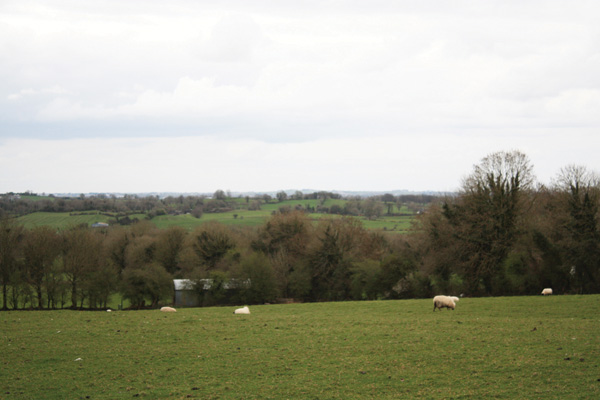
Looking towards Urraghry from Kilcommadan Hill |
|
The Grand Canal | |
|
In the early years of the 19th century, the Shannon Harbour to Ballinasloe section of the Grand
Canal was cut through the eastern side of the parish where it runs almost parallel to the river
Suck. The outline of its route is still clearly visible, despite the fact that it is no longer in use
and that vegetation thrives in its dried-out channel. The remains of the bridge over the canal at
Lismanny and the aqueduct which carried the canal over Ballinure River, are impressive relics
of its former glory.
|
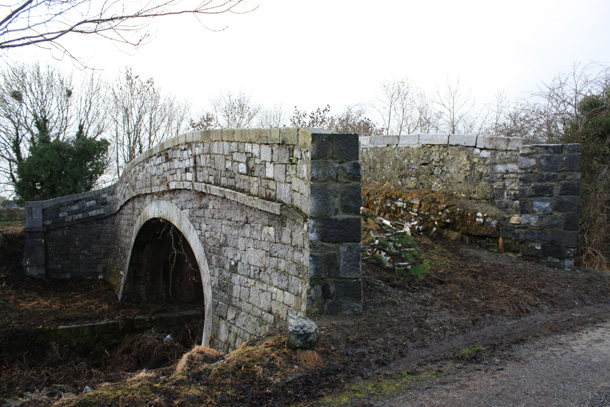
Grand Canal Bridge, Lismanny |
|
Churches Clontuskert is one of the oldest parishes in the diocese of Clonfert. There are two churches in the parish - St. Augustine's Roman Catholic Church at Crossconnell and St. Matthew's Church of Ireland at Glenloughaun. Both churches were built in the early years of the nineteenth century, having in common two beautiful stained glass windows donated by a Church of Ireland parishioner, James Barr of Rossgloss House. St. Matthew's lies in a delightful rural setting beside a quiet road, which runs along an east-west esker. St Augustine's is situated about two miles away on land given by the McDermott family of Ramore, Killimor. |
|
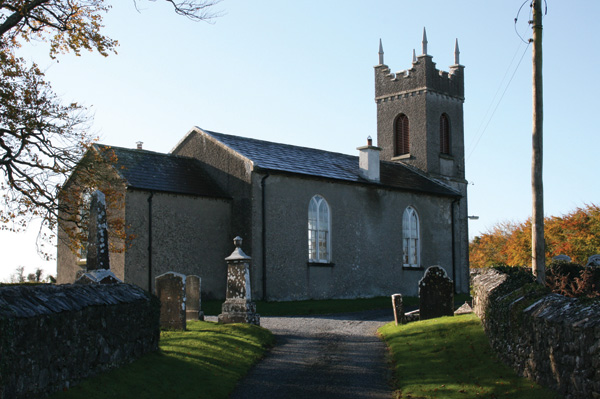
St. Matthew's Church |
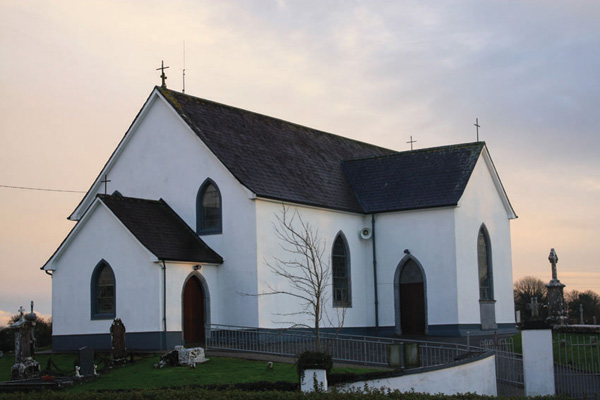
St. Augustine's Church |
|
Pollok of Lismanny | |
|
In 1854, Alan Pollok, a Scottish entrepreneur arrived and built a fine residence at Lismanny from which he oversaw the operation of the 29,000 acre farming enterprise which he had recently purchased. He quickly established one of the most advanced commercial farms in the Europe of
that time. Initially, his enterprise flourished but in the early years of the 20th century, decline set in and the Pollok family left the area for good. Very little now remains of the Pollok mansion or of the magnificent farmyard at Gannaveen.
|
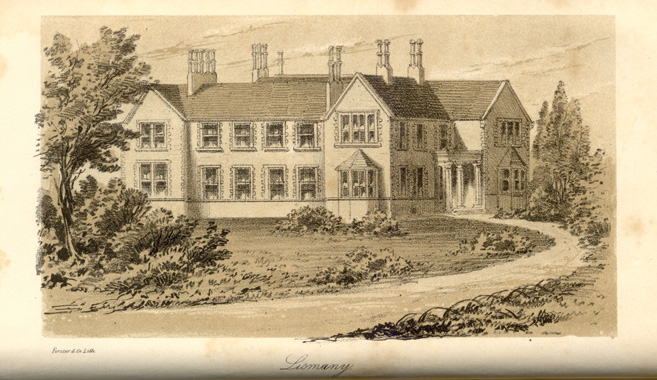
Lismanny House |
|
Kirwan's Lodge | |
|
About three kilometres from the edge of the Aughrim battlefield are the remains of Kirwan's Lodge in the townland of Tristaun. Here Annette Kirwan was born and reared. In 1879, she married Sir Edward Carson, the leader of the Irish Unionist Alliance and the Ulster Unionist
Party from 1910 to 1922. His statue stands before Stormont Castle in Belfast. Annette died at the early age of thirty-four.
|
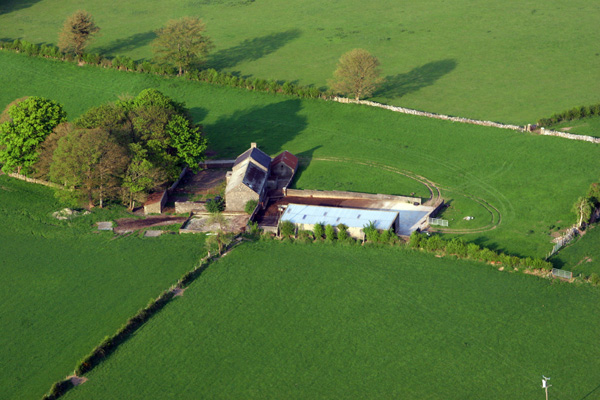
Site of Kirwan's Lodge |
|
Gortnamona House | |
|
Gortnamona House is a beautiful Georgian house set in its own parkland and made famous nationally by Percy French's song, The Woods of Gortnamona. A succession of families have lived in this place; Archdeacons, Burkes, Blakes, Cowans, Brennans, Lynams and
Salmons. Percy French was a close friend of Edward Lynam and was a frequent visitor to Gortnamona. During one of these visits, shortly after the death of his beloved wife in 1891, he wrote The Woods of Gortnamona, a lyric in which he expressed his feelings of deep loss.
|
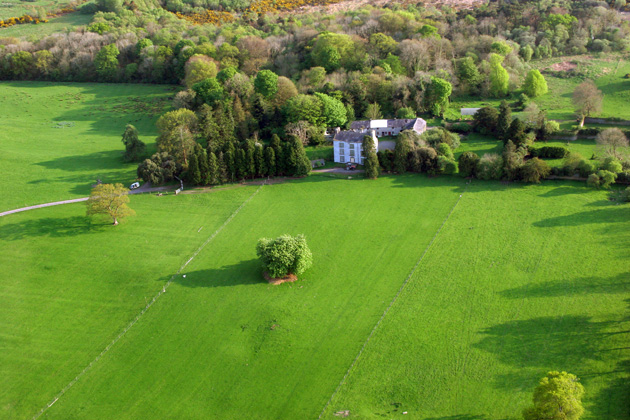
Gortnamona House |
|
Education Through the Years Prior to the early days of the nineteenth century, many of the children of Clontuskert were educated in the hedge schools situated around the parish. Some of these were located at Liskelly, Gannaveen, Crossconnell and Glenloughaun. The schools in Glenloughaun and Chapelpark provided a more formal education. Lord Clancarty established the former, beside the gate of St. Matthew's Church in 1819. The building of the latter commenced in 1835 and it continued as a school until the opening of the new school in 1958. |
|
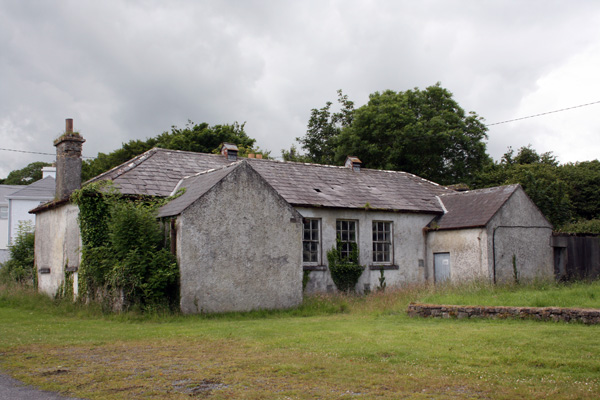
Old School Chapelpark |

Old School Glenloughaun |
|
Hurney's Replica Forge | |
|
Paddy Hurney was a blacksmith in Tristaun. His passion was to preserve for future generations many of the old traditions and the rich folklore of Clontuskert. In order to make his findings more immediately accessible to the people of the parish, he commissioned a set of videos on the rural way of life and built a replica forge, as well as a thatched Irish cottage, across the road from his smithy.
|
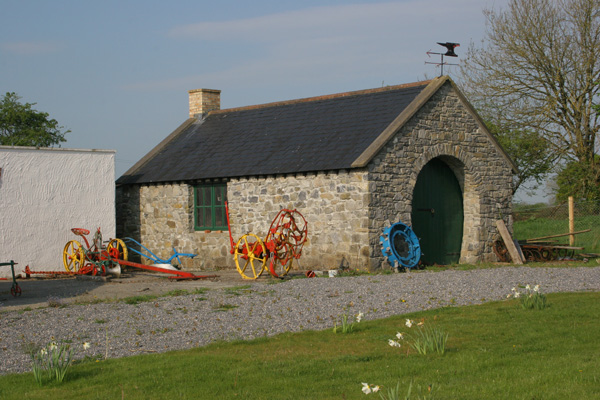
Hurney's Replica Forge |
